![]() |
|
|---|---|
Sports |
|
|
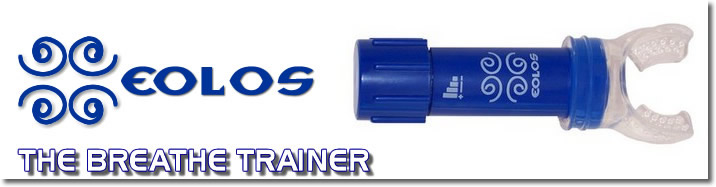
Eolos is the perfect training accessory for sportsmen interested in adding the most essential component (breathing) into their training program. Eolos is designed to train the muscles involved in inhaling and exhaling in one same breathing action while reinforcing a good breathing practice. The breathing muscles also play a vital role in stabilizing and rotating the upper body. In sports such as swimming, rowing, boxing and racquet sports, this secondary function of the respiratory muscles has obvious implications for the athlete who, at the same time is also trying to breathe as hard as possible.

A good (comfortable) breathing technique is only possible if your breathing muscles are in good shape. Using a breathe trainer such as Eolos, provides 'power and reserve' to the breathing process, making a workout more comfortable and enjoyable. The physical demand upon the breathing muscles increases extremely on what is known as the 'lactate threshold'. This exercise is associated with short intense bursts of activity and places the breathing muscles under sufficient strain that they become fatigued. Above the lactate threshold, breathing is driven to high levels because lactic acid stimulates it to increase as part of a compensatory strategy to overt fatigue of other muscles. The work associated with breathing limits athletic performance. Athletes who want to maximize their performance should address their breathing specifically, because their normal training fails to do so. Using a breathe trainer such as Eolos increases the power and endurance of breathing and improves athletic performance significantly.
Which muscles are involved in the breathing process? The muscles involved in breathing are the inspiratory and expiratory muscles. The inhalation muscles are diaphragm, external intercostals and accessory muscles. The exhalation muscles include the internal intercostals, abdominals, oblique, rectus.
Why is important to train both Expiratory and Inspiratory muscles? Breathing consists of moving the oxygen from the environment into the lungs, circulate it throughout the body, and removing carbon dioxide out. This process is called gas exchange. Inspiration results from enlarging the thoracic cavity and lowering the intrathoracic pressure to intake air. Exhalation occurs when relaxing the inspiratory muscles and the chest springs back forcing the air out of your lungs. During normal daily activities, you breathe at ease and the respiratory muscles do not experience hard work, hence blood flow to the peripheral muscles is normal. To give you a better idea, at rest a person breathes around 12 liters of air per minute, but during heavy exercise this can rise to over 150 liters per minute, and in elite athletes, this can go as high as 220 liters. When performing an exercise or an intense activity, the work of breathing increases making the respiratory muscles work harder. This causes fatigue and can reduce the blood flow, which limits physical performance. In the breathing process, the inspiratory muscles undertake most of the work; nevertheless, even though exhalation is mainly a passive process. The expiratory muscles are also demanded specially during heavy exercise. This is so since at high exercise intensity, the work of breathing increases and larger volumes of gas must be moved more quickly, therefore, greater pressure generation is required. By training the inspiratory and expiratory muscles we increase their strength and endurance, hence lessening their workload at intense exercise, allowing for proper blood flow to all active muscles and maximizing both respiratory and physical performance.
What causes inspiratory muscles fatigue? Muscles working hard in exercise need more oxygen, so more blood is pumped around the body, picking up more CO2 from the muscles, to be released in the lungs to be breathed out, and picking up more oxygen there to deliver to the muscles. When respiratory muscles demand for energy exceed supplies, the energy stored within the muscles is depleted and the force of contraction diminishes. Fatigue of the inspiratory muscles usually elicits an increase in minute ventilation and respiratory, and sometimes may result in a reduction rather than an increase in motor outflow to the respiratory muscles. The weakness experimented can be counteracted with a proper breathing training.
Breathlessness is the feeling of being out of breath. This is normal in healthy people who exert themselves physically, but can be a sign of illness if it occurs at a much lower level of exertion than expected. When the muscles are not in good shape, they cannot use oxygen efficiently and create less CO2. This inefficiency causes the heart and lungs to work poorly and experience breathlessness. By training your breathing you can strengthen the inspiratory muscles and use oxygen more efficiently to counteract the symptoms of breathlessness.
Why normal exercise is not enough to train my breathing? While any physical exercise enhances or maintains physical fitness and overall health, it is often practiced to strengthen muscles, the cardiovascular system, and to hone athletic skills. Nevertheless, this does not provide a training stimulus to the inspiratory and expiratory muscles. Various reports suggest that even well fit athletes can benefit from the 'super-enhancement' of inspiratory and expiratory muscles performance, which comes from training with a breathing trainer. Eolos provides a unique stimulus to the breathing muscles. This stimulus cannot be produced without imposing an external load to inhalation. The functional enhancement it stimulates provides improved capacity, endurance and control.
What is the Eolos training regime? The tested Eolos training regime consists of doing two sets of 30 breathing exercises using Eolos . Spending five minutes daily training, in four weeks you will feel the lung function improving.
Training 5 minutes daily, in 4 weeks the lung funtion improves noticeably. User-friendly instructions are included with every Eolos order. Measurable results can be achieved in about 3 weeks of continuous training. |
|---|
![]() |
Can Eolos improve breathing at high altitude?
Oxygen deprivation is usually a result from being at high altitude or just climbing up a flight of stairs.
There are two major kinds of environmental stresses at high altitude: climate and low air pressure. The percentage of oxygen in the air at two miles (3.2 km.) is the same as at sea level (21%). However, at a higher altitude, the air pressure is 30% lower because the atmosphere is less dense.
At high altitudes, the lower air pressure makes it more difficult for oxygen to enter our vascular systems. The result is hypoxia or oxygen deprivation. Hypoxia usually begins with the inability to do normal physical activities without fatigue.
When this happens, there is an increase in breathing and heart rate to as much as double even while resting. Pulse rate and blood pressure go up sharply as our hearts pump harder to get more oxygen to the cells. Under these conditions, just to put one foot in front of the other requires maximal levels of breathing. Physical performance is harder because the respiratory fatigue reduces the blood flow from the legs and arms to meet its own requirement for oxygen.
This fatigue of the inspiratory muscles can be counteracted by training your breathing with a breathe trainer as Eolos. This will prepare your breathing for the demands of the increased respiratory work at high altitude and minimize fatigue and breathlessness. In essence, you will be able to improve body performance and enjoy your activity at its fullest being this trekking, skiing or climbing.

Utilized correctly, Eolos can be used by almost anyone and has no harmful side effects. Very occasionally, however, there may be instances in which the creation of a large negative pressure in the chest may exacerbate an existing condition. As such, if you are on medication, suffer from a medical condition (asthma for example), or are uncertain as to whether Eolos is suitable for you, then you should consult your doctor prior to commencing training. Above all, unless advised by your doctor, you should not stop taking any medication. Eolos is intended to complement existing treatments, not to replace them.

- Other sections of interest:
| Copyright © 2006-2008 Aleas Europe LC | Anti Spam USA - SPAIN |